Sunday, June 5, 2022

Cottonwood FFA by Natalee


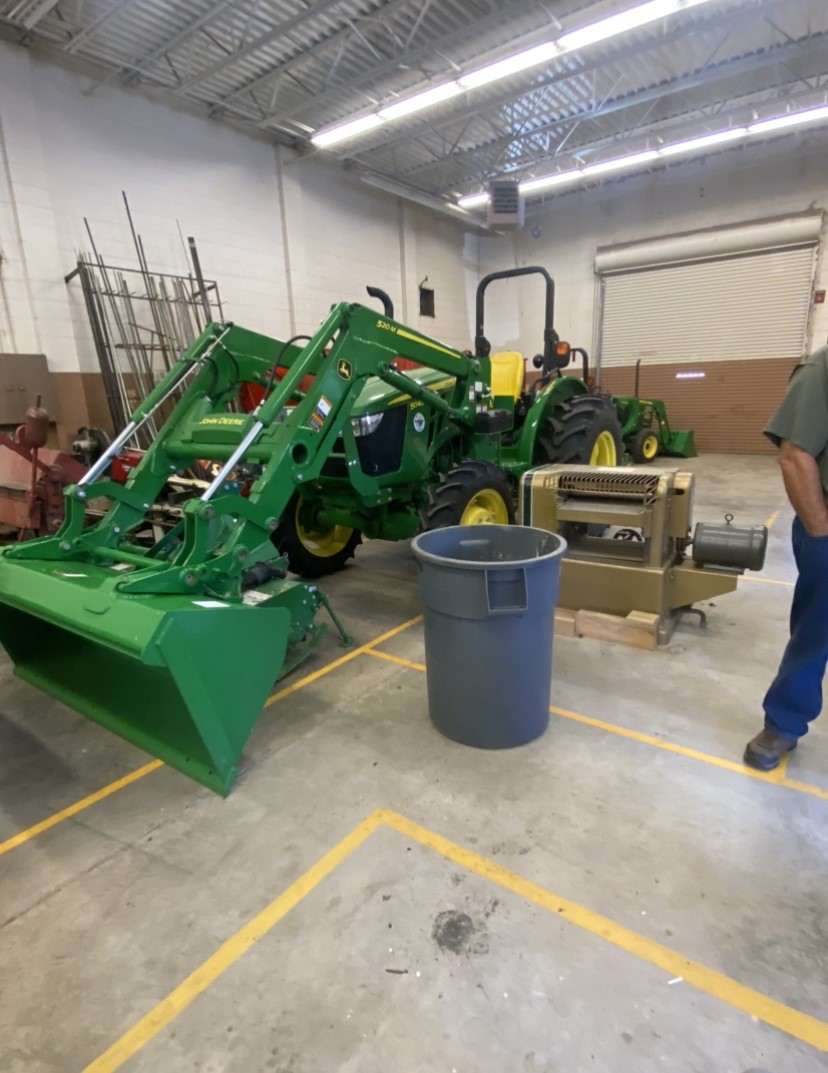
Cottonwood FFA was our last stop on our second day. This was one of the places I was most excited to visit. I find joy in seeing how not only other schools run their programs but a school in a different state. The classroom was set up much like ours with a class that leads to a shop however, their shop had a much higher ceiling and some loft areas for storage. While there, we viewed the classroom where classes are taught and they had a large display of  ribbons, banners and signs that represent their chapter and their winnings. We viewed where they would grow crops when in season and we took a walk to their barn to see their animal housing. 

Everything was similar as to how we run our ag program and how it looks but it was also very unique. The school is a school for all grades (pre K to 12), so when walking to the barn we saw the layout of the school and their playgrounds. Mr. Nathen Butler, the ag teacher and FFA Advisor, was very nice and let us have a few minutes to just be a kid after all of the educational information. 

We learned they have and Wildlife and Natural Resources class and they have hunting property next to their school, which they use during school. Us kids thought that was the coolest thing and all wanted to move to Alabama. Overall I think this was one of the coolest stops so far just because it was a good thing to see how another school runs their program. I was very impressed and very thankful that Mr. Butler was so kind to us.


FDACS by Abby


Our 4th stop on our trip, and our 1st stop on our 2nd day was at the Florida Department of Agriculture and Consumer Science(FDACS). Firstly we saw the herd of cracker cattle that they house at the facility. They are called cracker cattle because they are the living descendants of the original breeds that came over from Spain in 1521. They have multiple differing coat colors and patterns but they are trying to breed back to the original solid colors of the cattle rather than the spotted/speckled patterns. They are also breeding the cracker cattle and modern day cattle to create beef herds that fit todays beef market standards while keeping the high maternity rates and high disease resistances that the cracker cattle posses. 


Next we went to the FDACS marketing and advertising department where we learned about the “Fresh from Florida” state brand. They use that brand on commodities that were grown and processed in Florida. They have over 103 retail partnerships and their logo is used in 36 states in the U.S. and in 25 other countries around the world. Their goal is to spread awareness about their brand to the public and to help local businesses and farmers. They advertise directly to the public and explain what “Fresh from Florida” is all about and give recipes on some of the “Fresh from Florida” commodities. While also advertising to the members and farmers of “Fresh from Florida” and what exactly they offer to their business. They are continuing to grow and expand and we learned so much between the two departments and how they give back to the community that fuels these businesses. We are so appreciative of them and all that they provided for us, knowledgeably and souvenirs. Also, something that I thought was a little funny: FDACS marketing gave us their “Fresh from Florida” volume 8 2022 magazine and the Cedar Key Aquaculture Farm that was our first stop on day 1 was featured not once but twice in the magazine! It’s nice to see how well connected Florida’s agriculture community really is and what we all do for each other! 


Friday, June 3, 2022

Do you know how big a sturgeon is? by: Joseph

 We have successfully made it to Georgia! Throughout our long ride we stopped to visit the Sturgeon Aqua Farms. It was an amazing experience and the fish we saw were absolutely humongous! There was one that is worth 1.5 million dollars. that’s absolutely insane if you think about it. 

Sturgeon are raised in huge tanks. The nets around the side help to keep them from jumping out. Mr. Greg shared how these fish are raised.

A couple facts we learned about sturgeon were that they average about 10 feet in length and live in waters at about 24 degrees Celsius and that they are very interesting to touch. Kind of slimy like a catfish. They don’t have teeth as they are bottom feeders and feel around with there whiskers. They are like a over sized cat fish. 

It was a wonderful experience and if you ever have the chance go see these beautiful creatures

A huge thank you to all of our supporters for helping us get to where we are today.


Thursday, June 2, 2022

Beautiful Cedar Key by: Kieran


Good day everyone,


   On our first stop for the 2022 Riverview High School agriculture tour was the FWC (Florida Fish and Wildlife) Marine Lab at Cedar Key, FL. There was a kind lady named Leslie that gave us a tour and presentation on the clams and oysters of Cedar Key. She works with FWC and the University of Florida IFAS extension (INSTITUTE OF FOOD AND AGRICULTURAL SCIENCE) to improve breeding and genetics in clams/ oysters.  She talked about the variety of clams in Cedar Key. Some examples of the variety of clams she mentioned came from the East Coast of Florida and the Northeastern coast of North America (Prince Edward Island/New England area). Besides clams, she also talked about the oysters. She mentioned about oysters being a food resource for sea life, a water filter for the ocean, and a shelter resource. Clams are only harvested in Cedar Key because there are more clams than oysters and oysters tend to have more bacteria that are not healthy for human consumption. In the panhandle of Florida, oysters are harvested for commercial wholesale. 


Ms. Leslie teaching us about the nets that the clams are grown in as well as educating us on the reproduction and varieties of clams and oysters.


The inside of a clam!


These oysters are dead. They stick together to make a reef resource.


Next, we stopped by the Cedar Key Aquaculture Farms. They are the biggest clam business in the state of Florida. The process of catching clams and raising them is by a clam bag. They use black bags rather than light colored bags to prevent predators from consuming their product. Some examples of predators that consume crustaceans (such as clams and oysters) are stingrays, certain fish, and other invaders. They don’t actually use an aquaponics system to raise and harvest their clams, they actually have a water column in the Cedar Key area leased to them through one of the federal government agencies. They have these special boats to give them the ability to get into these shallow waters. After they catch these clams, they bring them back to their processing facility. They sort out clams through this “assembly line” to be able to make sure which clams are safe to eat for the consumer and which ones aren’t safe. If the clam shell is closed, it’s not safe to eat. Next, they go through to a refrigerator to head to the bagging process. After they sort out the clams based on size, they put a bunch of the clams that are the same size on the end of the machine. The machine forces the clams into one of the four pipes. The pipes lead to the bags tied up to the end of each pipe. After the clams are placed into the bag, the top of the bag is tied. After it’s tied, it’s weighed. Finally, it’s sent to COSTCO.  Yes, you heard that correctly! Costco is their biggest buyer’s. These Clams are sent to Costco locations ranging from Florida to New Jersey and from Florida to Louisiana. Make sure to stop by and grab your clams at your local Costco!


Harvested clams in baskets.


Clams are sorted and bagged with this machine.


Beautiful Cedar Key!

Before I check out, I want to state some fun facts.

 1. Did you know that 100 million clams are produced every year from Cedar Key?

 2. Cedar key is the clam capital of Florida.


This is Kieran checking out from the Ag Tour 2022 blog,


Forest Capital Museum and Homestead by: Mrs. H


Our second stop of Day 1 was at the Forest Capital Museum in Perry, FL. A special thanks to Mr. Jared Beauchamp for arranging for us to tour the museum and the Homestead. We appreciate Mr. Joe Mitchell coming in on his day off to share his knowledge of the history of the Homestead. All of the foresters who came were very knowledgeable and happy to share information on the displays and equipment.

The kids were especially surprised at how the sap was collected from the trees and how that was stilled into turpentine. Turpentine has many uses. What was left over after the turpentine was separated was a thick tar that was used as pitch to seal up boats.


The Cracker Homestead had several buildings that represented what you would have seen throughout Florida at the turn of the century. There were several pieces of antique equipment that would have been pulled by horses or ox. Sugarcane would have been pressed and cooked down into cane syrup. An old hollowed out log was used for scalding pigs when they were processed. There were lots of interesting things to see and stories to hear from Mr. Jared and Mr. Joe. This is definitely a place to come back and learn more.


Mr. Jared showed us some of the equipment they use.


Full Circle Dairy by: Angela

Full Circle Dairy was our last stop of day one. We were welcomed by the Watts family, Phillip, Ms. Cindy and Mr. Greg. We first saw all of the different ingredients that goes into their cattle feed. It was so cool seeing how they weigh all the different ingredients to a specific number and then mix it all together in a feed wagon, to make the feed. 

After, we got to see how they dry their sand that is used in the cow beds and then it is reused! They leave the sand to dry for 90 days before they put it back in the barn! Dry sand is very important because it helps prevent mastitis. Afterwards, we saw their lagoon which has 5 million gallons of water, Wow! 

Then we got to see some cows!! First we saw the two year old's and learned about how they eat and how they are kept cool during the hot summer. There are fans that are always on and water that sprays a mist and is on a timer. This system allows water evaporation to occur, which is the best way for cows to cool down. 

Then, we went to one of my favorite parts… the calves! They keep the calves in this area from only days old to 6 months. They have robotic feeders which read each calves tag and then allows them to drink their milk! These robotic feeders also prevent them from drinking more than they need as it knows how many times each calf has gone to drink milk, and will not give them anymore after they reach the allowed amount per day. While we were there, we also got to see how they make the milk for the calves! Hand mixing the formula for all of them would not be efficient, and frankly probably very tiring. Instead, they have a machine that pours out the right amount of formula and water into a blender. The blender mixes it all together and then the milk gets sent down tubes that run to the faux teet that the calves drink from! 

When we said our goodbyes to the calves, we got to the most interesting part of the tour in my opinion! We were able to see the process of milking the cows. The Full Circle Dairy uses a rotary milker! This very efficient milking process allows them to milk 500 cows an hour! The cows get milked 3 times a day, and it only takes 6-7 minutes. The milk gets sent to tanks which take 3 hours to fill and transports the milk to where it will get tested. Milk needs to be tested multiple times to insure that there is no bacteria in it as if it does not meet quality standards then it will be rejected. 

The milk that comes from Full Circle Dairy goes to many places like Dairy Queen and McDonalds! This concluded our tour of the dairy, but our amazing tour guides handed out goody bags and ice cream sandwiches that we all enjoyed! We are all very thankful for being able to tour the Full Circle Dairy as we learned so much and had lots of fun!


We are off!

 A long day 1... we apologize for the delay in our posts. 

On day 1 we visited the FWC Marine Laboratory, Cedar Key Aquaculture Farms, The Forest Capital Museum and Full Circle Dairy. 

Each day we ask a student, chaperone, parent or teacher to write on the blog to let you all know what stops were made, what we learned and share some pictures.

Please share the link to our blog with friends and relatives. See more pictures on our Facebook and Instagram (links are on the right).

Until Next Year

  This is the final entry for Summer Ag Tour 2022. Look for next year's blog as we travel to Illinois, Iowa, Wisconsin and Minnesota. Sp...